Take care!-If you do not speak I shall claim you as my own in some strange presumptuous way-Send me away at once if I must go
John Thornton (North and South)
From the moment I first came across North and South in a bookstore, I knew it was perfect for me. For a book that already has a strong-willed heroine with an emotionally restraint love interest, the only one way to make its premise more intriguing to me is to set it in Victorian England. North and South by Elizabeth Gaskell happens to meet all of these criteria. As much as I have always loved the idea of an Austen-like love story in a Dickens-like setting, these were just the hooks that tempted me to take up the novel. What truly made me fall for Gaskell’s characters were their steady growth throughout the novel, emotional internal reflection and complementing personalities. Through her characters and their lives, Elizabeth Gaskell showed readers the intricacies of living in 19th century England, the harshness of the industrial North and the obsolescence of the aristocratic South of her time.
The Victorian era was a time of massive socio-economic changes in England. When North and South was first published weekly in a newspaper in 1854, the country has already went through the first industrial revolution, in which many industries grew with unimaginable speed. Gaskell’s novel, whose name was actually penned by Charles Dickens, the original series’ editor, doesn’t just describe the contrast between the North, a region dominated by trade, and the South, a more traditional part of England. More than that, the novel dives deeper into the dynamics of the master-worker relationship, which, at the time, was growing more and more antagonistic. In order to give both the masters’s and the worker’s side equal opportunities to explain themselves, Gaskell designed the plot in such a way that Mr. Thornton and Higgins, representatives of the two sides, could take turns talking to the Hales about how they see the problem. North and South has some very ambitious goals and to an extend, reaches a fair number of them. Nevertheless, the novel hasn’t really been able to deliver a strong and powerful enough message in regards to its chosen topics, which, admittedly, are all very challenging. Despite its problems, North and South still has a special place in my heart, for I have fallen in love with its characters since I first met them.
Margeret Hale, whom Gaskell initially wanted to name the novel after, is one of the toughest and most affectionate heroines one could ever meet. During the eighteen months that she spends in Milton, Margaret has to go through all sorts of miseries. She losses both of her parents and a lovely new friend that she’s just made. The man whom she cares for sees her at the railway with her brother and thinks that she’s already has a lover. Margaret then returns to London to start a new life, only to find herself losing another loved one, her benevolent godfather. As cruel as life has been to her, it still couldn’t bring her down. After all the tragedies that befell her, Margaret emerges stronger and more independent than ever. She learns to manage the handsome inheritance her godfather left her, breaks free of her distant relations’ influence on her and takes control of her personal life. In addition to her assertive personality, Margaret also has a soft side for the people around her. She went to great lengths to attend to her sick mother’s needs, even if it’s something that is as dangerous as asking her brother, who was wanted by the law, to come home and lying to a police inspector to save him. When she was in Crampton Street, Milton, she took care of her poor worker friends, the Higgins, and their acquaintances, the Bouchers, regularly bringing them food and drinks to support them in their darkest times.
While all of the positive characteristics in the previous paragraph can be found in Margaret at almost any point of the novel, her open attitude to the differences of others, especially those that are her opposites, is something she develops along the way. When she first arrives in Milton, Margaret looks down on every manufacturer in town. It is not to say that these mill owners are all men of high moral standards and noble virtues; however, Margaret’s prejudices are mainly because of her general contempt for everyone in trade, including many more people than just Northern businessmen. In her defense, Margaret’s initial viewpoint is, for the most part, a result of her upbringing, a traditional and aristocratic one. Therefore, her change in belief, which happens after her deep involvement in the lives of people in Milton and her falling for Mr. Thornton, represents a central theme of the novel: overcoming class biases and outdated principals. By the time the novel ends, Margaret has learned to soften towards new ideas of the industrial North and appreciate those of other backgrounds.
If Margaret has to give up her elitist way of life, then Mr. Thornton must conquer his Northern pride. His transformation, which begins and ends much earlier than Margaret’s, is by no means less significant. Though he and Margaret starts from opposing point of views, their personal growth brings them together and teaches them how to love as well as understand one another. More than any other character besides Margaret, John Thornton is given a substantial amount of space to convey his inner feelings. Mr. Thornton, a classic self-made man who rose from a debt-ridden draper’s assistance to one of the most influential mill owners in the whole town, isn’t the expressive kind of people. Thus, to help readers understand the mind of the seemingly aloof Mr. Thornton, Gaskell occasionally allowed us access to the hidden thoughts of Milton’s most sought after man, who turns out to be a romantic at heart. With his constant struggle against his affection for Margaret, his desperate yearning to be near her and his agonizing pain in realizing that she may be with another man make Mr. Thornton one of the most sympathetic love interests ever. I don’t usually enjoy reading that many passages about passionate love, but Mr. Thornton’s noble love moves me. He does everything he in his power to help the Hales during their stay in Milton and even saves Margaret from legal problems despite thinking that she has chosen someone else over him.
Furthermore, Mr. Thornton is more than just a suitor of the protagonist; in fact, to some extend, one can argue that his role as a hard-hearted Northern mill owners is just as essential to the message of the novel. In the the early stage of his acquaintance with Margaret, Mr. Thornton and his unsympathetic view on others, especially his workers, clash with Margaret’s compassion for the sufferings of the working-class. Though he’s neither scheming nor manipulative, he is far from a good master. Mr. Thornton is always honest about his business decisions, the wages that he pays and the condition of his mill, but when it comes to the lives of the people that are working for him, he doesn’t care if they are homeless or if their children are starving. However, as he gets closer to the Hales, especially Mr. Hale and his daughter, Mr. Thornton starts to change for the better. He agrees to hire Higgins, a leader of a full-on strike across Milton, when no other master wants to take in the poor man. Mr. Thornton’s interaction with Higgins, which increases as time goes by, continues to improve his temperament and teach him to be more aware of those around him. He and Higgins set up a kitchen in Malborough Mills so that workers can buy better food at a lower price. Near the end of the novel, Mr. Thornton himself visits the place and eats with his employees several times. Through his transformation, Gaskell gave readers hope about the relationship between masters and workers, despite the possible conflict interest at times.
North and South is a must-read for anyone who wants to learn more about Victorian England. Once you finishes the book, you should try its 2004 and 1975 adaptation of the same name. The novel and the two BBC miniseries will definitely bring you a lot of pleasure.
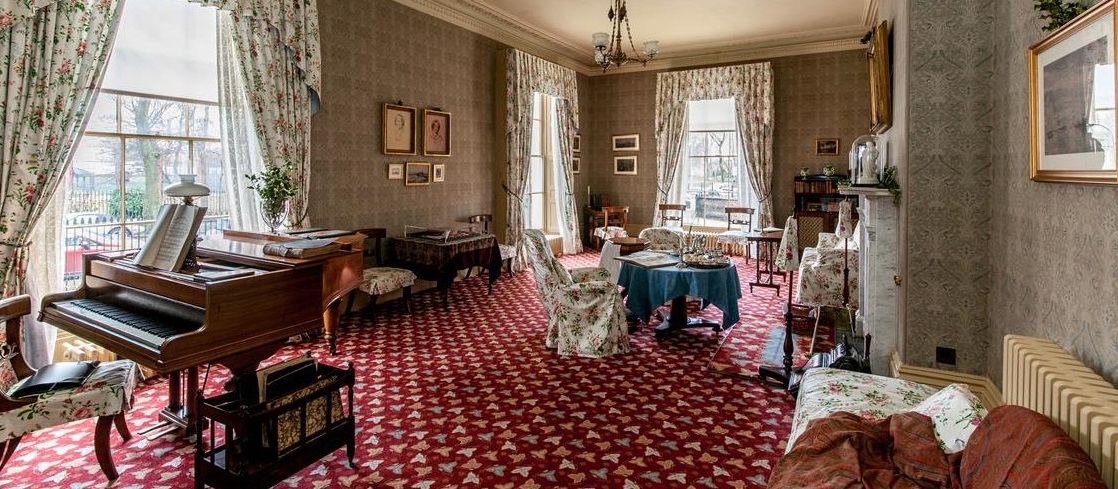
Below is a picture of Elizabeth Gaskell house in Manchester.
 A sleepy conscience